Loaded Carries: The Most Underrated Move for Core Stability and Longevity
Key Takeaways
- Loaded carries walking while holding weight train your core, grip, posture, and balance all at once.
- They mimic real-life movement patterns, making them practical for long-term strength and injury prevention.
- Even short sessions (5–10 minutes) can improve stability, coordination, and daily functional strength.
- Different variations farmer’s carries, suitcase carries, overhead carries target different muscle chains.
- Consistency matters more than heavy weight; controlled walking and posture deliver the biggest benefits.
Introduction: Why Simple Strength Is Trending in 2026
The wellness conversation in 2026 looks different than it did even five years ago.
People aren’t just chasing six-pack abs or marathon PRs anymore. Instead, the focus has shifted toward functional longevity the kind of strength that helps you carry groceries, hike with friends, lift a suitcase overhead, or play sports well into your 60s and beyond.
That shift has brought renewed attention to movements that were once reserved for athletes and strength coaches. One of the most overlooked? Loaded carries.
At first glance, the exercise looks almost too simple: pick up weight, walk, and keep your posture steady.
But behind that simplicity is a powerful training effect. Loaded carries activate deep core stabilizers, shoulders, hips, and grip muscles simultaneously, creating a full-body stability challenge without complicated equipment.
Many trainers quietly call them “the missing link” between strength training and real-world movement.
Yet despite their benefits, loaded carries are still rarely included in everyday workouts.
Let’s talk about why.
The Problem: Why Traditional Core Training Often Falls Short
Walk into most gyms and you’ll see the same pattern repeated everywhere:
- Endless crunches
- Plank challenges
- Ab machines with fixed movement paths
These exercises certainly have value, but they often miss a crucial piece of the puzzle: movement under load.
Your core isn’t designed only for bending forward during sit-ups. Its primary job is stability preventing excessive movement while the body moves through space.
Think about daily life:
- Carrying groceries from the car
- Holding a child on one hip
- Walking with a backpack
- Lifting and transporting boxes
These activities require the body to resist rotation, stabilize the spine, and coordinate muscles across the entire body.
Traditional ab exercises isolate the core, but they rarely train it the way it actually functions.
Another challenge is overcomplication in modern fitness culture. Social media workouts often emphasize flashy exercises that look impressive but may not build foundational strength.
Loaded carries flip that idea on its head.
They return to a simple concept: strength that travels with you.
Instead of lying on the floor performing isolated reps, you’re:
- Standing
- Walking
- Stabilizing weight
- Maintaining posture
Your body becomes an integrated system.
Many physical therapists and coaches also appreciate carries because they encourage natural posture alignment shoulders down, ribs stacked over hips, and core gently braced.
That alignment can support healthy movement patterns over time.
So if the goal is long-term strength, resilience, and coordination, loaded carries fill a gap many traditional workouts leave behind.
The Trendspore Framework: 4 Pillars of Effective Loaded Carry Training
After interviewing coaches and reviewing movement research, we’ve organized loaded carry training into four practical pillars. Think of this as a simple roadmap for building real-world stability.
Pillar 1: Start With Posture Before Weight
One of the biggest mistakes beginners make is choosing weights that are too heavy.
Loaded carries aren’t about brute force. They’re about control while moving.
Focus first on these posture cues:
- Tall spine (imagine a string pulling your head upward)
- Shoulders relaxed and slightly back
- Core gently engaged
- Slow, controlled steps
If posture collapses, the weight is too heavy.
A useful guideline: choose a load you can carry for 30–40 seconds while breathing comfortably.
This builds the habit of stable movement under manageable stress, which is the real goal.
Pillar 2: Rotate Through Different Carry Styles
Different carry variations challenge different parts of the body.
Here’s a quick breakdown.
Loaded Carry Variations and Their Focus
| Carry Type | How It’s Done | Primary Benefit |
|---|---|---|
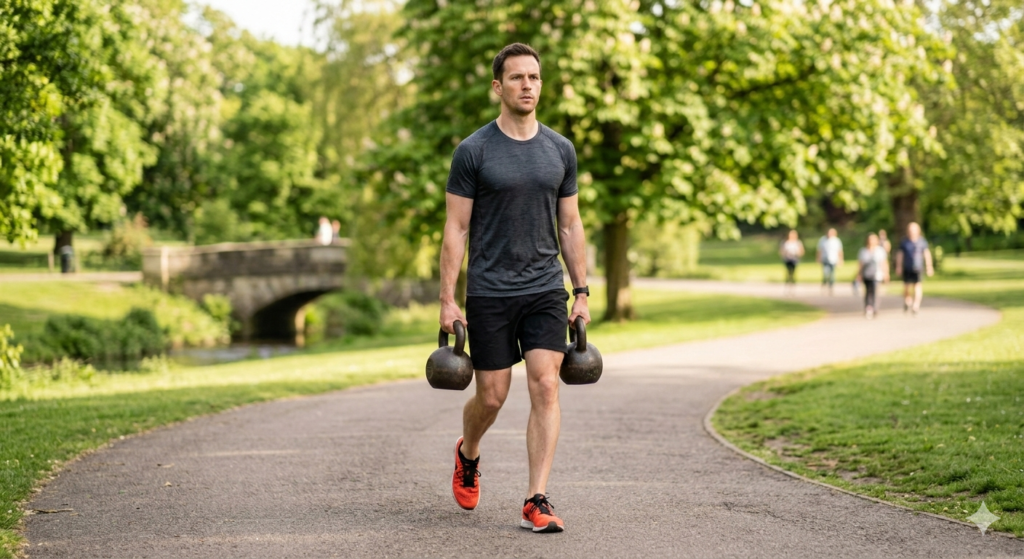
| Farmer’s Carry | Weight in both hands at sides | Full-body strength and grip |
| Suitcase Carry | Weight in one hand only | Anti-rotation core stability |
| Front Rack Carry | Weights held at shoulder level | Posture and upper-back strength |
| Overhead Carry | Weight held overhead | Shoulder stability and core engagement |
| Waiter Carry | One arm overhead, one arm down | Balance and coordination |
Rotating through these styles ensures the body trains multiple stability systems rather than repeating one movement pattern.
Pillar 3: Walk Slowly, Not Far
Distance matters less than quality movement.
Fast walking often leads to sloppy posture and swinging weights.
Instead:
- Walk slowly and deliberately
- Take short steps
- Keep the weight close to the body
A typical beginner carry might look like this:
- Walk 20–30 meters
- Rest 30 seconds
- Repeat 3–5 rounds
Even this small volume can activate dozens of stabilizing muscles.
Pillar 4: Think of Carries as “Moving Planks”
A helpful mental shift: treat loaded carries as planks in motion.
Instead of holding a static plank position, you’re stabilizing while walking.
This activates:
- Deep abdominal muscles
- Obliques
- Lower back stabilizers
- Glutes and hips
- Grip and forearms
The result is a chain reaction of muscle engagement that many isolated exercises miss.
Pillar 5: Train Consistency, Not Exhaustion
For longevity-focused training, consistency wins.
Loaded carries work well because they’re:
- Low-impact
- Time efficient
- Adaptable for many fitness levels
You don’t need hour-long sessions.
Even 5 minutes at the end of a workout can reinforce posture and core stability.
Daily Routine Integration
The best exercises are the ones that fit naturally into your day.
Here’s how loaded carries can slide into a realistic routine without requiring a full gym session.
Morning Stability Routine (10 Minutes)
Morning movement helps wake up stabilizing muscles after sleep.
Try this quick sequence.
- Bodyweight Warm-Up (3 minutes)
- Arm circles
- Gentle torso rotations
- Light walking
- Suitcase Carry (3 rounds)
- 20–30 seconds each side
- Rest 30 seconds
- Farmer’s Carry (3 rounds)
- 30 seconds walking
- Focus on posture
- Breathing Reset (1 minute)
- Slow nasal breathing
- Relax shoulders
This short routine primes the body for daily activity.
Evening Reset Routine (8–12 Minutes)
After a long day of sitting or studying, carries can help restore posture awareness.
- Front Rack Carry – 3 rounds
20–30 seconds - Light Farmer’s Carry Walk
1–2 minutes continuous walking - Gentle Mobility
- Chest stretch
- Hip flexor stretch
- Shoulder rolls
This combination helps balance the body after hours of desk posture.
Sample 7-Day Loaded Carry Tracker
| Day | Carry Variation | Duration | Notes |
|---|---|---|---|
| Monday | Farmer’s Carry | 4 rounds | Focus on posture |
| Tuesday | Suitcase Carry | 3 rounds each side | Core balance |
| Wednesday | Light Walk + Carry | 5 minutes | Recovery day |
| Thursday | Front Rack Carry | 4 rounds | Upper-back strength |
| Friday | Farmer’s Carry | 5 rounds | Grip endurance |
| Saturday | Mixed Carries | 10 minutes | Variety session |
| Sunday | Rest or Light Carry | Optional | Gentle movement |
This kind of light structure helps build a habit without feeling like a strict workout program.
Nutritional & Fitness Synthesis
Movement and nutrition always work better together.
Loaded carries rely heavily on muscle endurance, hydration, and energy stability, which makes everyday nutrition important.
You don’t need complicated diets to support this style of training. Instead, focus on three foundational habits:
1. Protein for Muscle Support
Protein helps maintain muscle tissue that stabilizes joints and posture.
Examples:
- Eggs
- Yogurt
- Beans and lentils
- Chicken or fish
- Tofu
Even spacing protein across meals can support recovery from strength-based activities.
2. Hydration for Joint Comfort
Walking with weight increases joint demand.
Staying hydrated supports:
- Muscle contraction
- Joint lubrication
- Energy levels
A simple guideline many trainers use: drink water regularly throughout the day rather than all at once.
3. Whole Foods for Steady Energy
Loaded carries feel best when energy levels stay steady.
Focus on balanced meals that include:
- Fiber-rich carbohydrates
- Healthy fats
- Protein
Here’s a quick example.
| Meal | Example |
|---|---|
| Breakfast | Oatmeal with yogurt and berries |
| Lunch | Rice bowl with vegetables and protein |
| Snack | Nuts and fruit |
| Dinner | Vegetables, whole grains, and lean protein |
Simple meals often support consistent training better than restrictive eating plans.
The Verdict: Why This Simple Move Deserves More Attention
Loaded carries aren’t flashy.
They don’t involve complicated machines or trending fitness gadgets.
But they do something many exercises don’t: train the body as a coordinated system.
By walking with controlled weight, you strengthen posture, grip, and core stability at the same time.
For anyone focused on long-term health, that combination matters.
Start small. Carry light weight. Walk slowly.
With consistent practice, this simple movement can become one of the most practical tools for building strength that supports everyday life.
Quick FAQ
Are loaded carries safe for beginners?
Yes. Beginners can start with light weights like dumbbells or kettlebells. Focus on upright posture and slow steps. Short sets of 20–30 seconds help build coordination without excessive strain.
How often should I do loaded carries?
Two to four sessions per week works well for most people. Many trainers add them at the end of workouts or as part of a short daily movement routine.
What muscles do loaded carries work?
Loaded carries activate multiple muscle groups, including the core, shoulders, grip, glutes, and upper back. The body works as a stabilizing system while walking with weight.
Can loaded carries help posture?
They may support posture awareness because you must keep your chest upright and shoulders stable while carrying weight. Practicing this position during movement reinforces good alignment habits.
Do I need heavy weights for results?
Not necessarily. Moderate weights with controlled walking often provide plenty of stimulus. The goal is maintaining steady posture and balance rather than lifting the heaviest load possible.
Suggested Long-Tail Keywords (Use as H3s)
- Benefits of loaded carries for core stability
- How to do farmer’s carries correctly for beginners
- Loaded carry workout for functional strength
- Best carry exercises for posture improvement
- How loaded carries support long-term fitness

Ricki Hewitt is an advice, support, mental health, and inclusion professional with over eight years of experience across higher education, healthcare, and the voluntary sector. With a career built on the belief that inclusive environments empower people to truly thrive, Ricki brings a depth of knowledge and compassion to every aspect of their work.
Specialising in supporting individuals with disabilities, neurodivergence, mental health conditions, and complex personal circumstances, Ricki has developed a holistic, person-centred approach rooted in pastoral care, safeguarding, casework, and tailored learning support. Their work is guided by a commitment to improving wellbeing, retention, engagement, and progression by embedding accessibility and inclusion into every stage of the human experience.
Throughout their career, Ricki has worked across universities, healthcare services, and community organisations, delivering meaningful change through evidence-based support, inclusive practice, and collaborative working. Their extensive expertise spans disability support, reasonable adjustments, safeguarding, mental health interventions, equality, diversity, inclusion and belonging (EDIB), widening participation, and multi-agency partnership working.
Beyond frontline support, Ricki has led impactful projects and initiatives focused on accessibility, student engagement, LGBT+ inclusion, and organisational culture change demonstrating a commitment to systemic, lasting transformation rather than surface-level fixes.
At Switch to Nature (switchtonature.com), Ricki draws on this wealth of professional experience to explore the powerful relationship between nature, wellbeing, and inclusive living. Driven by the conviction that inclusive practice should be proactive, compassionate, and embedded within culture rather than treated as an afterthought, Ricki writes to help people from all backgrounds feel seen, supported, and genuinely empowered.
Whether through individual stories, evidence-informed insights, or practical guidance, Ricki’s writing reflects a lifelong dedication to creating equitable, human-centred spaces both online and in the world.
Connect with Ricki and explore more at: www.switchtonature.com